In the rapidly evolving world of AI-generated content (AIGC), while Diffusion models have become the industry standard, they often struggle with two major challenges: following complex instructions and rendering precise text.
Recently, the Z.ai team introduced GLM-Image. As the first open-source, industrial-grade discrete auto-regressive (AR) image generation model, it combines the "intelligence" of Large Language Models (LLMs) with world-class visual performance.
1. Core Architecture: The Brain and the Brush#
The defining feature of GLM-Image is its innovative hybrid architecture, which leverages a "tag-team" approach between two powerful technologies:
The "Semantic Brain" (Auto-regressive Module)#
Initialized from GLM-4-9B, this module boasts 9 billion parameters of pure understanding. It doesn't just "draw"; it "reads" and interprets your prompts. By using semantic-VQ technology, it captures low-frequency semantic signals and determines the global layout of the image with incredible accuracy.
The "Fine-Art Brush" (Diffusion Decoder)#
To solve the texture and detail limitations of traditional AR models, GLM-Image integrates a 7-billion-parameter DiT Diffusion Decoder (based on the CogView4 architecture). It takes the "semantic blueprint" from the brain and refines it into high-fidelity visual outputs, ensuring every strand of hair and every play of light is rendered perfectly.
2. Key Advantages: Why GLM-Image Stands Out#
Precision Text Rendering#
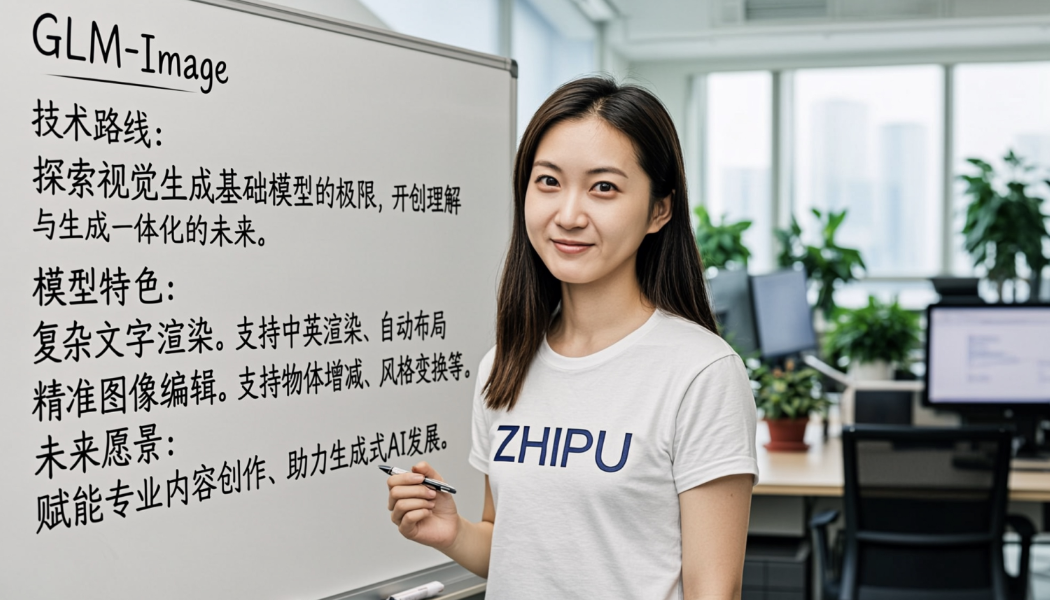
This is perhaps GLM-Image’s most stunning breakthrough. While other models often produce "gibberish" when asked to include text, GLM-Image utilizes Glyph-ByT5 technology to specialize in character-level encoding—particularly for Chinese characters. Whether it's a complex Hanzi or a multi-line layout, the text remains crisp, accurate, and legible.
Deep Knowledge & Semantic Alignment#
Thanks to its GLM roots, the model excels in "knowledge-intensive" scenarios. If you ask for a scene containing specific historical elements or complex logical relationships, GLM-Image is far less likely to "hallucinate" compared to pure diffusion models, ensuring the output is both creative and factually grounded.
A True "All-Rounder"#
GLM-Image is far more than just a Text-to-Image (T2I) tool. It natively supports:
- Image Editing: Precise modification of specific areas.
- Style Transfer: One-click transformation of artistic styles.
- Identity Preservation: Ensuring character faces remain consistent across different scenes.
- Multi-Subject Consistency: Managing multiple distinct objects within a complex composition.
3. Use Cases: From Creativity to Productivity#
GLM-Image is set to revolutionize several key industries:
- Advertising & Graphic Design: Generate commercial posters, logo mockups, or product pages with accurate Chinese slogans, significantly reducing the revision cycle.
- Content Creation & IP Branding: With its "identity-preserving" capabilities, creators can easily develop storybooks, comics, or storyboards while keeping character appearances perfectly consistent.
- E-commerce & Social Media: Rapidly create high-quality product imagery with the ability to swap backgrounds or adjust lighting precisely.
- Education & Science Communication: Produce diagrams and educational visuals with accurate labels and data points, making visual communication more rigorous.
4. Conclusion#
The open-source release of GLM-Image is not just a technical milestone; it is a gift to the global AIGC community. It proves that the "AR + Diffusion" hybrid path is a highly effective solution for complex visual generation challenges.
If you are looking for a model that understands Chinese, follows logic, and delivers breathtaking image quality, GLM-Image is undoubtedly the top choice in the open-source world today.