As we step into 2026, looking back at the 2025 token usage data from OpenRouter reveals a narrative of explosive growth and a fundamental shift in the AI power balance. What began as a market dominated by a few "frontier" giants has evolved into a hyper-competitive ecosystem defined by cost-efficiency and specialized performance.
1. The 8x Explosion: AI Scaled to the Masses#
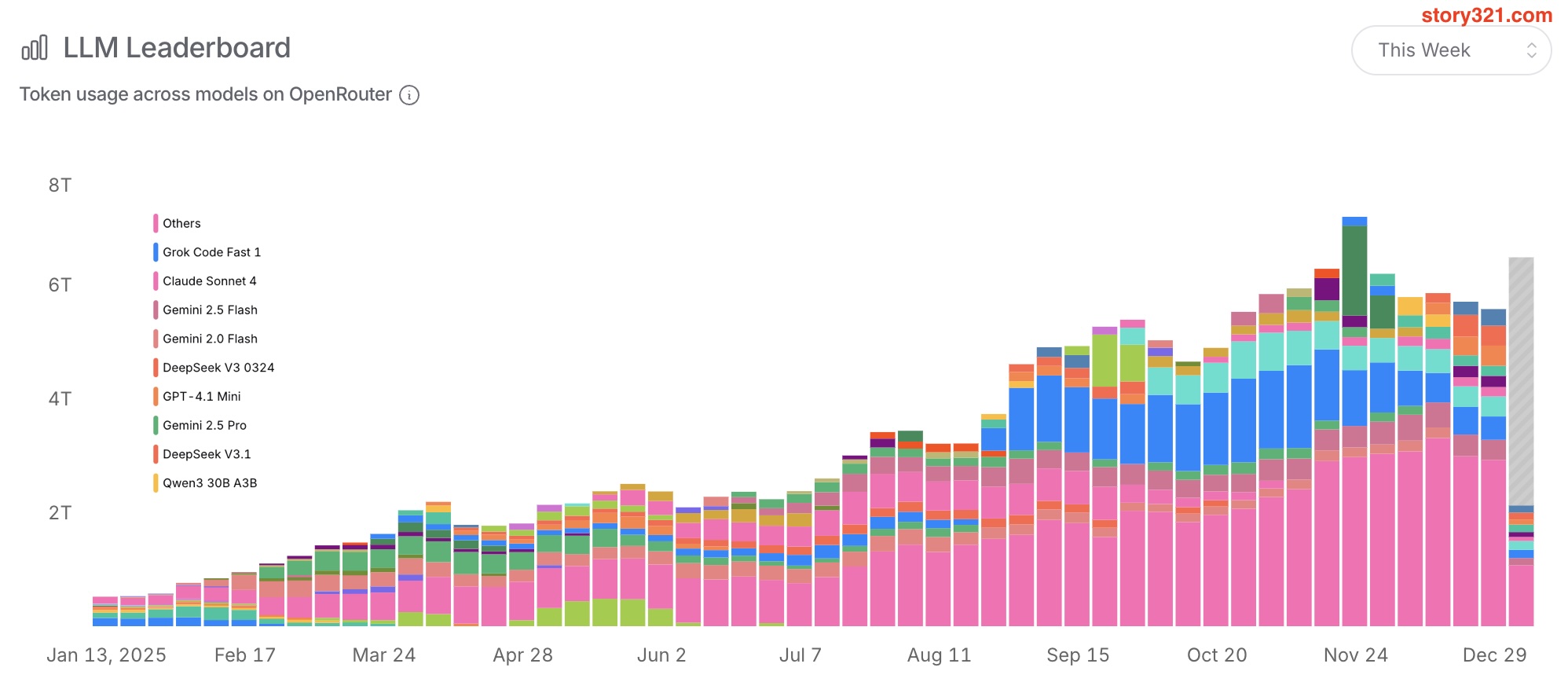
The most striking takeaway from the 2025 chart is the sheer volume. In January 2025, weekly token usage sat well below 1T (trillion). By late November, it peaked near 8T, before stabilizing around 6T by year-end.
This isn't just incremental growth; it’s a total integration of AI into the global developer workflow. We are no longer just "testing" LLMs; we are running entire infrastructures on them.
2. The Dominance of "Flash" and "Mini"#
The chart colors tell a clear story: Efficiency won 2025.
- Google’s Gemini Era: The massive pink and reddish blocks representing Gemini 2.5 Flash and Gemini 2.0 Flash dominated the mid-to-late year. Google’s strategy of offering massive context windows at low latency successfully captured the lion's share of high-volume traffic.
- GPT-4.1 Mini: OpenAI’s "Mini" strategy remained a staple (orange block), proving that for many developers, a reliable, mid-tier model is preferable to a heavy, expensive flagship for daily tasks.
3. The Rise of the Disruptors: DeepSeek & Qwen#
2025 was the year "Value Models" became "Performance Leaders."
- DeepSeek's Surge: The emergence of DeepSeek V3 (0324 and 3.1) in the latter half of the year correlates with a significant squeeze on older legacy models. DeepSeek didn't just compete on price; it competed on intelligence, particularly in coding and logic.
- Qwen3’s Late Entry: Look closely at the final week of December. Qwen3 30B A3B (yellow) makes a notable appearance. Though a latecomer to the 2025 leaderboard, its rapid adoption suggests that Alibaba’s latest offering is set to be a titan in 2026.
4. Specialized Strengths: Coding and Reasoning#
The 2025 landscape also saw the rise of the "Specialists":
- Grok Code Fast 1: The blue spikes in the fourth quarter highlight xAI’s successful push into the developer market. When speed in code generation became the priority, Grok saw massive adoption.
- Claude Sonnet 4: Anthropic maintained a loyal, high-value user base. Even as "Flash" models took the volume, Claude Sonnet 4 remained the gold standard for nuanced reasoning and creative output, holding a steady section of the leaderboard.
5. The Fragmentation of "Others"#
Perhaps the most interesting part of the chart is the vast "Others" category at the bottom. This represents the long tail of the AI revolution—fine-tuned Llama variants, niche vertical models, and experimental architectures. It signals that we are moving away from a "one-model-fits-all" world and into a multi-model strategy where developers pick the specific tool for the specific task.
Final Thoughts#
2025 was the year the "Intelligence Tax" dropped. As models like DeepSeek V3.1 and Gemini 2.5 Flash made high-level reasoning affordable, the barrier to entry for AI-native startups vanished.
In 2024, we asked: "Can it do this?" In 2025, we asked: "How cheaply and fast can it do this?"
As we move into 2026, the focus shifts again—this time toward Agency. With models this fast and this cheap, the era of autonomous AI agents is no longer a forecast; it is our current reality.