Silicon Valley's "Same-Day Duel"#
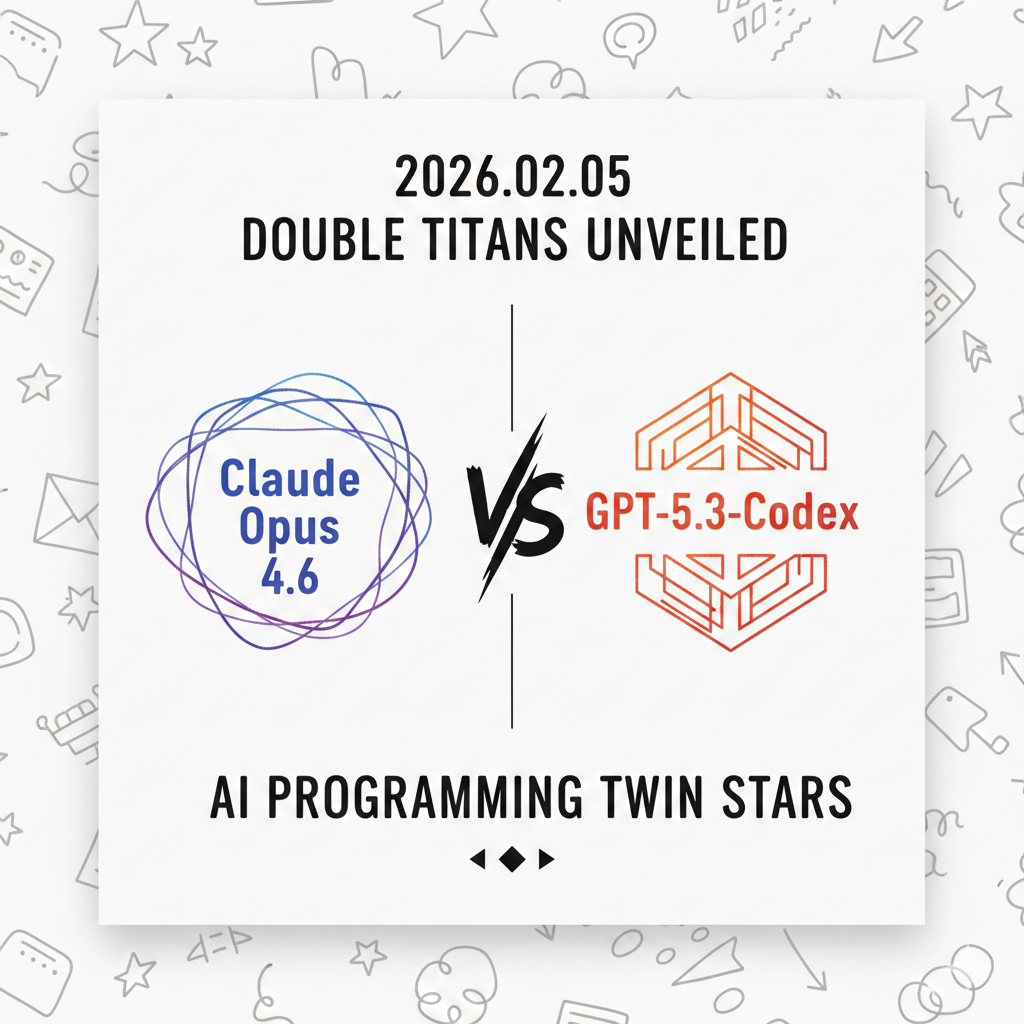
February 5, 2026, is a day destined to be written into the history of AI development.
In the morning, Anthropic released Claude Opus 4.6, featuring a breakthrough upgrade with a million-token context window.
In the afternoon, OpenAI swiftly responded by launching GPT-5.3-Codex, emphasizing autonomous programming and cybersecurity capabilities.
The two companies chose to release their strongest programming models on the same day, merely hours apart. Behind this lies the signal of intensifying competition in the field of AI programming.
The two main contenders in this duel each have their own strengths: Claude Opus 4.6 is the "Thinker," known for its massive context window; GPT-5.3-Codex is the "Action Taker," focused on autonomous programming capabilities.
So, what breakthroughs do these two models actually bring? And how should developers choose?
Claude Opus 4.6: The Boundary-Pushing Thinker#
The biggest highlight of Claude Opus 4.6 is its million-token context window.
A leap from the previous generation's 200K tokens directly to 1 million tokens—a fivefold increase. What does this mean?
1 million tokens is roughly equivalent to 750,000 English words.
In practical terms, you can feed an entire large codebase, complete technical documentation, or all the code from multiple projects to Claude at once, and it can comprehend and analyze this content.
In programming scenarios, this means Claude can perform code analysis across thousands of files, understanding the architecture of the entire system, not just individual functions or modules.
Beyond the context window, Claude Opus 4.6 brings other upgrades:
- 128K token output: Doubled from 64K, enabling it to generate longer code and documents.
- Agent Teams: Multiple AIs collaborate to complete complex tasks, like a professional team.
- Adaptive Thinking: An extended thinking mode is activated for complex problems.
Practical cases have already proven its capabilities. In tests, Claude Opus 4.6 discovered 500 zero-day vulnerabilities, successfully handled tasks related to the Linux kernel, and even developed a C compiler.
Ideal Use Cases: Large codebase analysis, long document processing, complex tasks requiring deep reasoning.
GPT-5.3-Codex: The Pioneer of Autonomous Programming#
If Claude is the Thinker, then GPT-5.3-Codex is the Action Taker.
Its core breakthrough is autonomous programming capability. GPT-5.3-Codex is the first AI model to participate in its own construction process—it helped debug its own training code.
This isn't just assisted programming; it's a paradigm shift from "helping you write code" to "writing code for you."
Besides autonomous programming, other highlights of GPT-5.3-Codex include:
- 25% speed increase: Faster response times compared to the previous generation.
- 50% token efficiency improvement: More tasks can be handled for the same cost.
- First "High-Capability" cybersecurity model: Achieved a score of around 90% on CVEBench.
- Terminal-Bench 2.0 score of 77.3%: An industry-leading level.
In the field of cybersecurity, GPT-5.3-Codex also sets a new benchmark. It is the first model labeled as a "High-Capability" cybersecurity model, capable of performing security audits, vulnerability detection, and penetration testing.
Ideal Use Cases: Autonomous programming projects, security auditing and testing, rapid iterative development.
Head-to-Head: Key Data at a Glance#
Let's look at the numbers to see how the two models perform on key metrics:
| Comparison Dimension | Claude Opus 4.6 | GPT-5.3-Codex | Winner |
|---|---|---|---|
| Context Window | 1 million tokens | 400K tokens | Claude |
| Output Tokens | 128K tokens | 128K tokens | Tie |
| Terminal-Bench 2.0 | 65.4% | 77.3% | GPT (+12%) |
| Speed Increase | Not specified | +25% | GPT |
| Core Feature | Agent Teams | Autonomous Programming | Different Strengths |
Based on the data, each has its own victories:
- Claude wins decisively on context window: 1 million vs. 400K means Claude has a clear advantage when processing long texts and large codebases.
- GPT leads in coding benchmarks: A Terminal-Bench 2.0 score of 77.3% vs. 65.4% indicates better performance in practical programming tasks.
- Output capability is comparable: Both support 128K token output, capable of generating sufficiently long content.
But this is not a zero-sum game. The two models have different positioning and suit different scenarios.
Choose Claude for long-context processing, choose GPT for autonomous programming—that's the conclusion.
What Does This Mean for Developers?#
What are the implications of this duel for developers?
For Programmers#
First and foremost, it means improved efficiency. Whether it's Claude's massive context window or GPT's autonomous programming, both can significantly reduce coding time.
But more importantly, it signifies a shift in role. The value of a programmer is shifting from "writing code" to "designing systems." The AI helps you write the code, while you are responsible for designing the architecture and solving problems.
For Product Managers#
Prototype development accelerates. Functional prototypes that used to take weeks might now be completed in days. The cycle for requirement validation is significantly shortened, and the cost of trial and error is reduced.
For Enterprise Decision-Makers#
Tool selection requires scenario matching. It's not about choosing one over the other across the board, but selecting based on specific needs:
- Need to analyze a large codebase? Choose Claude.
- Need autonomous development tasks? Choose GPT.
- Limited budget? Claude's API pricing might be more flexible.
- Need enterprise-level support? Both offer enterprise versions.
The real winners are the developers who skillfully use these tools.
Outlook: 2026, The Inflection Point Year for AI Programming#
February 5, 2026, might be marked as the inflection point for AI programming.
From this day on, two clear trends are emerging:
First, a paradigm shift from "Assisted Programming" to "Autonomous Programming."
GPT-5.3-Codex's involvement in autonomous programming signifies that AI is no longer just an辅助工具(assistant tool), but can independently complete development tasks. This is a qualitative change.
Second, the era of tool combinations has arrived.
The competition between Claude and GPT gives developers more choices. Smart teams won't choose just one; they will use them in combination according to the scenario:
- Use Claude to analyze codebases and understand the overall architecture.
- Use GPT to implement specific features and automatically generate code.
- Using both together multiplies efficiency.
Anthropic vs. OpenAI—the biggest winner in this competition is the developer.
In 2026, the war of AI programming has just begun. And we are standing at the turning point of history.